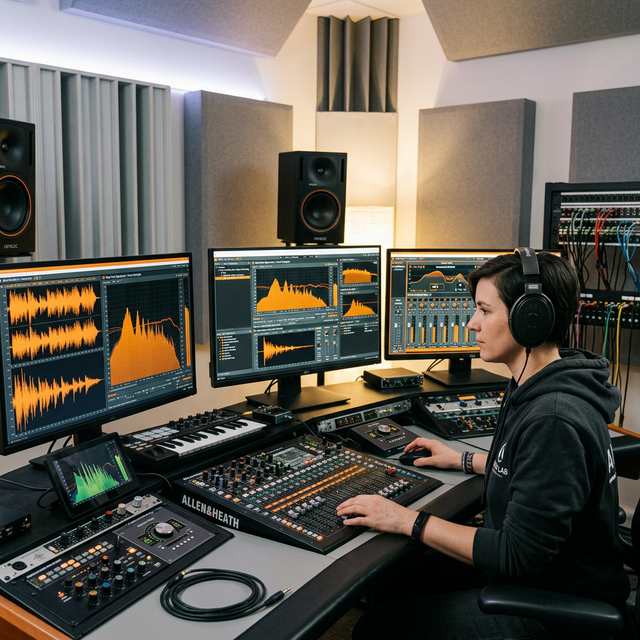
Sound Event Recognition & Model Training
Turn raw audio into reliable decisions. We train custom sound event recognition models for your specific events and environment — from machinery anomalies and glass breaks to vehicle classes and animal calls — and deploy them on-device for low-latency, privacy-preserving inference. Combined with complementary sensor modalities where it matters, we deliver models that hold up outside the lab.
Key Benefits
Custom Event Taxonomy Definition
Dataset Collection & Annotation
Data Augmentation for Robustness
Model Architecture Selection
Edge-Optimized Training (Quantization, Pruning)
Multi-Modal Sensor Fusion
On-Device Deployment
Field Validation & Continuous Improvement
False-Positive Mitigation
Model Versioning & OTA Updates
Our Process
Event Definition & Feasibility
We work with you to define the target events, the acoustic environment, and success metrics. We assess feasibility against the available data, sensor constraints and deployment target.
Data Collection & Annotation
We build or extend a representative dataset — from controlled recordings to in-field capture via our sensor platforms — and annotate it to the taxonomy defined in step one.
Model Training & Tuning
We train edge-optimized models using architectures suited to your constraints, apply data augmentation for robustness, and iterate on precision, recall and false-positive behaviour.
Edge Deployment
We quantize, prune and package the model for on-device inference on our Embidio platform or your target hardware — ensuring latency and memory budgets are met.
Field Validation & Continuous Improvement
We validate performance in the real deployment environment, collect failure cases through our device management platform and iterate on the model through OTA updates.
Frequently Asked Questions
Ready to Start Your Project?
Contact us to discuss how our sound event recognition & model training services can help you achieve your goals.